
With a youth unemployment rate of roughly 10%, Africa’s jobs crisis does not look exceptional at first glance. The problem becomes clear when you examine what kind of work young people are engaged in.
Every year, between 10 and 12 million young Africans enter the workforce, yet the continent creates only 3 million formal jobs to absorb them. Without a social safety net, many of them cannot afford to wait for work that matches their skills, so they turn to informal jobs that meet immediate needs but are low-productivity, low-wage, and offer limited opportunity for career progression. Nearly 90% of employed African youth work informally.
For the last decade, selling digital services globally looked like one of the more promising paths to creating high-productivity work at scale. AI is now changing that bargain: it weakens the case for companies outsourcing high-volume, low-cost work. But it also strengthens the case for something more ambitious: large firms that use the technology to help African talent become more productive and trusted to sell higher-value outcomes to the world. This essay explores the new AI frontier and opportunities for high-value job creation in the digital sector.

Why High Productivity Jobs Matter
High-productivity jobs matter because they produce more value per unit of labor, and that value is multiplicative. For example, work that lets an engineer design a more effective manufacturing process has a different economic effect from work in which that engineer operates a machine through rote tasks. The former expands what other engineers are able to produce. At scale, that kind of work can raise the income floor for everyone else in the economy. That is how a young, skilled population becomes an economic advantage.
Every economy that has meaningfully raised incomes has found ways to pair productive labor with capital, and to produce goods or services that other countries were willing to pay for. Those exports then bring foreign exchange, investment, and the capacity to innovate across the economy.
Several East Asian economies built this capacity through export manufacturing. In addition to a skilled, low-cost workforce, China, for instance, made heavy capital investments. By 2011, fixed investment had risen to about 44% of GDP, nearly twice the world average and far above Sub-Saharan Africa’s 24%. The result was GDP per capita rising roughly 10x over a 20-year period. That path required reliable power, logistics, physical infrastructure, and policies that made large industrial investments viable, foundations that remain underbuilt across African markets.
For India and the Philippines, the path was exporting business services by combining relatively low-cost talent with investments in education, telecommunications, and global service delivery. They became central players in the IT and business-process-outsourcing (BPO) industry, creating millions of middle-income jobs in the process.
For many African countries, services have looked more immediately accessible than manufacturing. Internet use has more than doubled over the last decade, with the share of Africans using the internet rising from 16% in 2013 to 37% in 2023. Digital payments, online marketplaces, and a wave of investment in digital skills also exist; Mastercard Foundation alone has committed more than $770 million across Africa to empower people with digital skills.
Over the last decade, African countries have started making inroads into this industry, from IT-enabled services firms to small agencies and solo freelancers navigating global platforms. A 2025 report by Caribou Digital and Genesis Analytics estimates that Africa’s BPO and IT-enabled services sector now employs just over 1 million people, representing 2% of global supply. And just as it is beginning to take off, AI is changing the shape of the industry.
AI is changing the services-export bargain
Historically, the biggest pull for outsourcing professional services was cost arbitrage. A firm in a wealthy country could send well-defined work to a lower-cost country because the savings outweighed the friction of managing that work at a distance.
Today, for a growing share of well-defined tasks, the cheapest capable option is an AI model. At this time last year, LLMs could already build websites and applications with help. Today, advanced reasoning models require significantly less hand-holding and can complete far more complex tasks, and those capabilities continue to improve rapidly.
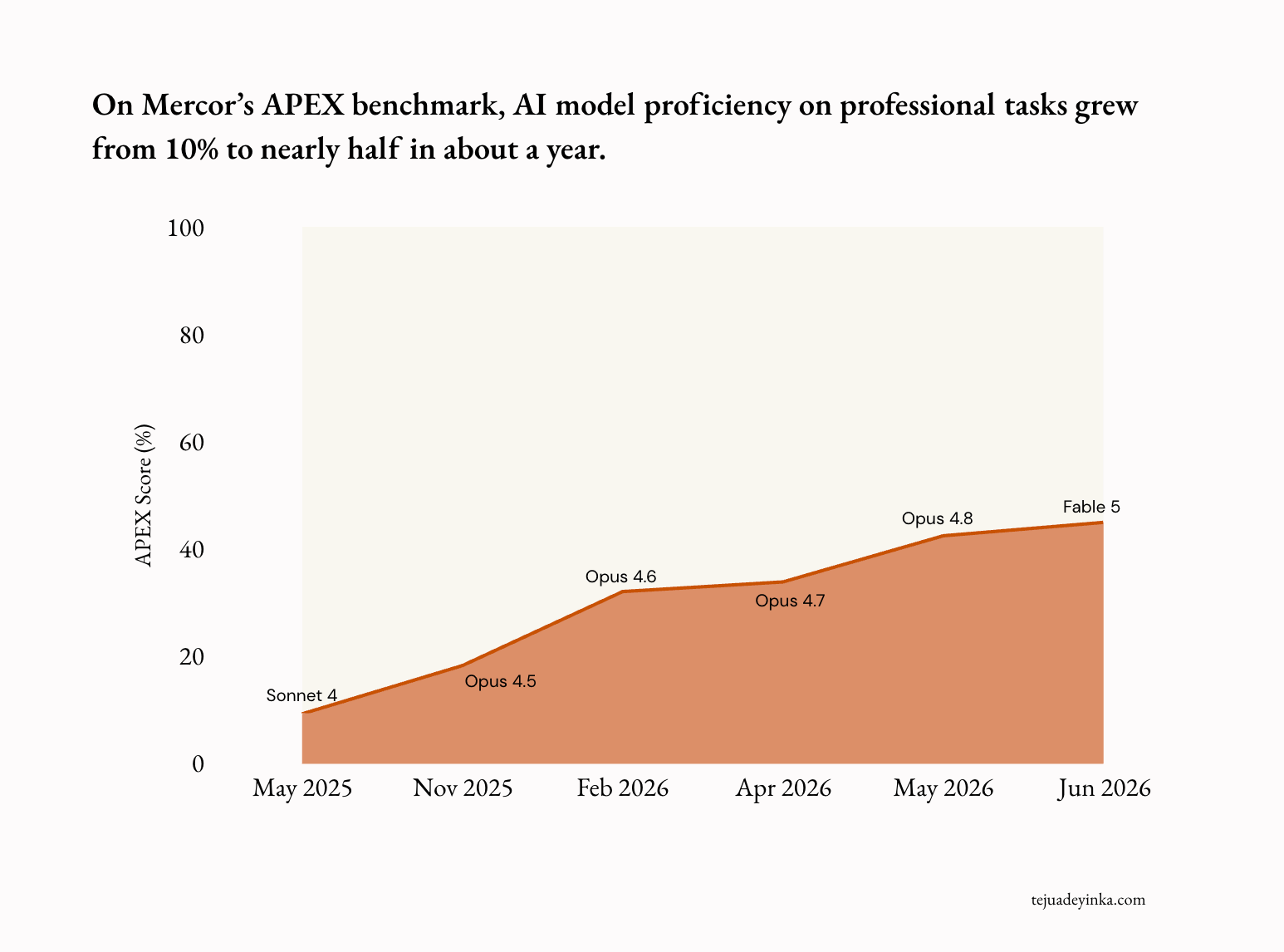
This matters directly for Africa’s emerging outsourcing sector: the same Caribou Digital report estimates that nearly 40% of tasks in Africa’s BPO and IT-enabled services sector could be automated by 2030.
The displacement evidence is already visible in some categories. Ramp, a corporate spend management platform, analyzed company spending from 2021 through 2025 and found that firms most exposed to AI sharply reduced spending on online labor marketplaces like Upwork and Fiverr. For every dollar of reduced spending on these platforms, these firms spent only about three cents more on AI tools, suggesting that some previously outsourced work is getting dramatically cheaper with AI.
The trend is concerning for countries whose services-export strategy depends on large volumes of relatively standardized work.
However, this change is not linear. It will affect industries and talent pools unevenly, closing some pathways while creating new asymmetries and, potentially, new opportunities.
Data from the same period shows the other half of the picture. While spending on freelance marketplaces fell, demand for work tied to AI on those platforms grew quickly. On Upwork, demand for skills connected to applying AI, such as integrations, data annotation, and chatbot development, grew 109% year over year in 2025.
Model capability is only one input into a hiring decision. Companies also weigh cost, regulation, customer expectations, and the consequences of errors. As a result, for some work, the most “intelligent” system is not necessarily the best tool. The relevant differentiator may be empathy, responsiveness, or originality. Game design is one example: the novelty from a person’s unique lived experience might be the difference between a video game that resonates with its audience and one that falls flat.
The more useful question, then, for talent and outsourcing agencies is not whether AI will eliminate work, but where it will create new demand for human skill. To this, I see three shifts:
AI can make previously uneconomic services viable.
A central idea in disruption theory is that technology can turn non-consumption into consumption: it can make a service cheap or simple enough to become accessible for use cases or customer segments where it was previously too expensive.
AI may do the same for services. At the 2025 edition of Stripe Sessions, Mark Zuckerberg made a point I found interesting: it had never been feasible for Meta to build a customer-support team for social-media users, which is why most complaints go unanswered. If AI makes it possible to triage many of those cases, it could create demand for human support around the residual work AI cannot resolve. It is unclear whether Meta has made, or will make, that investment. But the example illustrates a broader possibility, including in higher-stakes sectors such as healthcare, diagnostics, compliance, and research: AI can expand the frontier of what kinds of services humans can deliver profitably.
AI can raise the ceiling for workers and firms, moving them to higher-value work.
Because AI tools are accessible across borders, most productivity gains are less tied to location than earlier waves of industrial technology. They can also be used by talent in lower-income countries to produce higher-quality work. This is especially true as open-source models improve. Additionally, AI might reduce the challenges of coordination, making it more feasible for companies to outsource more complex, high-value work end to end.
That means talent in African countries can move into higher-value tasks that may previously have been out of reach. For instance, Sourcing Sprint trains non-software engineers to build automated workflows for businesses in a matter of weeks, and has placed them in jobs. AI is expanding the range and complexity of work that “non-technical” talent can learn to deliver.
Beyond direct employment, this productivity shift could help entrepreneurs build more globally competitive products and services. They can iterate faster, focus on their areas of differentiation, and use AI to extend what small teams are able to do.
AI creates new forms of work that require humans.
Building, training, and governing AI systems takes people, and the demand runs across model training, evaluation, AI safety and deployment. Some of this work is well suited to globally distributed talent, since it depends on careful human judgment and input rather than physical proximity. Companies such as Mercor have built their businesses around sourcing the human expertise that goes into training frontier models. There is also growing demand for demonstrations and data collection for physical AI, a category of work that barely existed at scale a few years ago.
The largest opportunity, though, may lie in deployment. As models are deployed inside enterprises, we are beginning to get more evidence of the gap between model capability and the ability to produce value for businesses. Organizations need people who understand their context, choose worthwhile problems, redesign processes, and take responsibility for implementation.
The demand is showing up in hiring data. Postings for forward-deployed engineers and deployment-strategist roles, the people who go into an organization, study how it works, and make sure AI delivers on its promise, rose by roughly 8x between January and September of 2025, according to an analysis by Indeed and the Financial Times. Anthropic’s $150M Claude Corps program, which places early-career fellows inside nonprofits to put AI to work, points in the same direction. From the job descriptions of the companies hiring for these roles, the qualities that make deployment talent effective are judgment, communication, problem-solving, and creativity.
AI will only deliver value in the most consequential sectors and organizations when people can adapt it to real constraints and carry the work through to an outcome. And if there is one thing humanity has in abundance, it is problems to solve. With them come opportunities for highly productive human labor to partner with machine intelligence.
Across these shifts, the pattern is the same: the demand is real, but it will not necessarily be captured by being the cheapest option. As AI lowers the cost of many standardized tasks, the value moves toward work that is harder to specify, harder to verify, and more dependent on judgment.
For African talent, the opportunity is therefore not to become a larger pool of low-cost workers using AI. It is to build firms that use AI to help local talent deliver high-quality work to global customers. A customer who buys managed support, a research process, or compliance outcomes does not need to know whether ten people, two people, or two people with good systems did the work. They need the work to be accurate, reliable, secure, and on time, and they need to trust the institution delivering it.
This requires an ecosystem of its own: employers who can win client trust, help talent develop complex skills, develop AI capabilities and deliver work end to end at a global standard for specific verticals.
Talent development is one piece of that ecosystem. Over the last decade, hundreds of millions in patient capital have gone into training and developing talent across the continent. The next step is activation: preparing people for the skills that will be increasingly valuable, such as judgment, critical thinking, and decision-making, and creating pathways for those skills to be demonstrated and rewarded.
AI can help make that possible. In Erik Brynjolfsson’s Stanford class last quarter, my team and I built a product that used custom simulations and evaluations to help people practice judgment, critical thinking, and decision-making in realistic scenarios. It also gave employers a way to assess capabilities that are often hard to measure through traditional credentials or interviews.
The hardest piece is also the most important: trust. Building client trust to execute complex work at a distance is slow and expensive, but it is possible. Andela did it for software engineering. Superside did it for design. Infosys and Accenture did it at a much larger scale across managed professional services. Each created a trust and delivery layer between global customers and distributed talent.
Africa needs more firms that can play that role, especially in industry-specific verticals and in the judgment-heavy work AI is pushing value toward. Size matters because high-value work is bought from trusted institutions, and larger firms can amortize the expensive parts of the model: sales, client management, quality assurance, training, security, brand-building, and delivery infrastructure. If those firms can be built, each one could become a source of high-value jobs across many industries.
On UBI and why waiting is not a strategy

Some technologists argue that reskilling and job-creation approaches are ultimately the wrong projects because AI will drive the value of human expertise toward zero. They believe the focus should be redistributing the wealth that accumulates to frontier labs and the owners of AI infrastructure, often through UBI programs.
That future is possible, but it rests on several assumptions that are far from settled.
First, it assumes that intelligence alone resolves society’s constraints. It does not. Risk tolerance, coordination, regulation, and the unpredictability of the real world still matter. It is unclear that we will ever arrive at a world where we can, or would want to, automate every task that exists, digital or physical. That leaves a residual category of work that economists from Baumol to Chad Jones argue may become more valuable as more of the economy is automated.
Second, it assumes that productivity gains will be broadly globally distributed even if labor is no longer central to creating value. That is difficult to believe, given the history of the world. It may be possible within a nation-state, through taxation and redistribution policies. But the argument becomes much weaker across borders. If the wealth from AI accumulates to frontier labs, compute providers, and capital owners in a few countries, what happens to countries that do not own those assets? How do they fit into a post-work political economy?
And even if that future arrives in a decade, as some proponents believe, young people need viable work in the interim. A strategy for the next ten years cannot rest on waiting for the distributional details of a post-work economy to resolve themselves.
The more immediate question is what we can do now. How do we train people for the skills that will continue to matter, including judgment, long-range thinking, domain expertise, coordination, and complex problem-solving? How do we connect those capabilities to global demand? And how do we build the firms that can turn those capabilities into trusted output?
Africa’s young population is only an asset if it can become productive labor. AI increases the risk that the old outsourcing playbook will narrow before it has reached enough people. But it also creates an opportunity to build a better one: a labor market in which African talent can use AI to deliver higher-value work, build globally competitive companies, and capture more of the value it creates.
That is the space I am exploring at Stanford, including through research with the Digital Economy Lab and Stanford GSB’s Impact Design Immersion Fund. I am especially interested in connecting with researchers, founders, outsourcing teams, funders and operators building in this area. Feel free to reach me on LinkedIn.
Thank you to Aleph for reading and editing multiple versions of this.
Sources
African Development Bank, Jobs for Youth in Africa Strategy (10–12 million youth enter the workforce annually; ~3 million formal jobs created).
Mastercard Foundation / World Data Lab / UCT DPRU, Africa Youth Employment Outlook 2026 (~90% of employed young Africans work informally).
World Bank, GDP per capita (current US$) – China (China GDP per capita time series).
Electronics and Computer Software Export Promotion Council (ESC), India software services exports 2024–25 (computer software and services, including ITeS and BPO, reached ~$222B).
IT and Business Process Association of the Philippines / Philippine News Agency, PH IT-BPM revenue and employment 2024 (~$38B; ~1.82M FTE jobs).
World Bank / ITU, Individuals using the Internet (% of population), Sub-Saharan Africa.
Mastercard Foundation, Digital focus area (digital-skills programming across Africa).
Caribou Digital & Genesis Analytics, Preparing for AI in the BPO and ITES Sector in Africa (1M+ jobs; nearly 40% of tasks automatable by 2030).
Ramp Economics Lab / Ryan Stevens, Payrolls to Prompts: Firm-Level Evidence on the Substitution of Labor for AI (freelance-marketplace spend and AI-substitution evidence).
Upwork, In-Demand Skills 2026 (AI-related skill demand grew 109% year over year).
Financial Times, The new hot job in AI: forward-deployed engineers (FDE/deployment-strategist posting growth).
Anthropic, Introducing Claude Corps ($150M fellowship program placing early-career fellows with nonprofits).
Chad Jones, AI and Economic Growth (Baumol bottlenecks and automation).
Aghion, Jones & Jones, Artificial Intelligence and Economic Growth (Baumol’s cost disease and AI-growth constraints).
World Bank, Gross fixed capital formation (% of GDP) – China / World / Sub-Saharan Africa (fixed-investment comparison).
Clayton M. Christensen, Heiner Baumann, Rudy Ruggles & Thomas M. Sadtler, Disruptive Innovation for Social Change (disruption theory and non-consumption framing).
Stripe Sessions 2025, A conversation with Mark Zuckerberg (Meta customer-support / AI services example).
Chris Quintero, LinkedIn post on Sourcing Sprint initiative (Sourcing Sprint training and placement example).
Business Insider, Mercor pays over $1.5 million a day to humans training AI (Mercor human-expertise / AI-training-work example).
Khosla Ventures, AI: Dystopia or Utopia? (Vinod Khosla’s post-work / abundance / redistribution view of AI).
Good read. I am also a big proponent of tapping into higher skilled labor on the African continent for BPO services, and in my day to day job I witness first hand the ability of agentic tools to take even people with mediocre critical thinking skills and still deliver useful results as long as 1) this talent pool is able to get guidance on the functional aspects being delivered to end users from the subject matter experts and 2) they have set up the right AI skills to enhance their thinking & automate repetitive tasks in the end to end delivery workflow.
That said, it can be a highly frustrating process for companies outsourcing this work to this talent pool, as I alluded earlier that the critical thinking gap is quite large in some cases. That gap can be closed though, that is for sure and that closure accelerates rapidly with AI adoption. The key lies in training this talent pool on how to deeply use agentic tools to enhance how they think about problem solving and what is being delivered to end users.
Speaking purely from a technology standpoint, in my mind, the future of software delivery is much smaller teams of highly paid subject matter experts that use agentic tools to create detailed functional specifications that fully articulate the benefit being delivered to the end user. Those people then create a template of clear instructions that can be implemented and tested by offshore talent that require some baseline level of critical thinking skills (but less so than the experts), and who can also use AI to deliver their work. Then a final user acceptance testing is performed by the subject matter experts. This entire end-to-end workflow can be done using AI genetic tools.
Where African talent fits in this picture is that offshore talent part, but they can only be successful in this position if they fully understand how to use agentic tools to understand what functionality is delivered to the end user, why their contributions matter, and ultimately how they can automate and scale their deliverables with AI.
good stuff homie💜